SELECTED REFERENCES











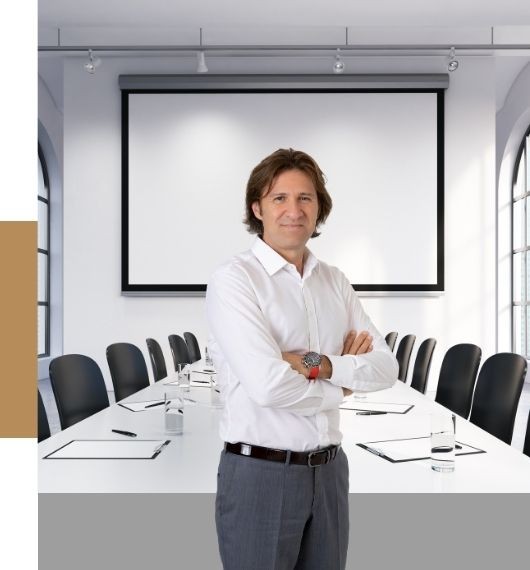
Gökhan Uğurlu
Founder | Chief of Staff | Board Advisor | Transformation Leader
I work directly with CEOs and executive leadership teams to transform complex organizational challenges into measurable business results.
Throughout my career spanning more than 30 years, I held senior executive positions at global organizations such as Bosch Siemens, Samsung Electronics, and Azersun, where I led large-scale structural and cultural transformation programs.
Today, through Optimist Consulting, the firm I founded, I help organizations accelerate their growth, transformation, and corporate development by applying this extensive experience to real business challenges.
My expertise goes beyond developing strategies and making recommendations—I work hands-on to ensure that strategy is successfully executed and delivers lasting business impact.
SERVICES
Corporate Academy Programs
Individual Transformation Programs
Years of Experience
Projects
Training Programs
Participants
FREQUENTLY ASKED QUESTIONS
Effective management and leadership training is a comprehensive development process designed for professionals who hold management responsibilities within organizations or are preparing to take on leadership roles. This training aims not only to provide managerial knowledge but also to enhance managers’ behavioral skills, decision-making capabilities, and team management competencies. At Optimist Consulting, the training approach is tailored according to the organization’s current structure and objectives, focusing on creating practical outcomes that can be directly applied to real business environments.
The effective leadership training program enables managers to recognize their own leadership styles and improve their effectiveness. Participants develop essential leadership skills such as communication, team motivation, providing feedback, and delegating responsibility through practical exercises. This process helps managers adopt an effective leadership mindset while building stronger and trust-based relationships with their teams.
The effective leadership model used in the training provides a flexible framework that can adapt to different team structures and organizational needs. Through this model, managers develop leadership behaviors suitable for changing business conditions and gain a more strategic perspective in decision-making processes. The program also provides practical tools for measuring and improving leadership impact.
The management training programs offered go beyond individual development and aim to support overall organizational performance. Throughout the training process, topics such as performance management, goal-oriented team leadership, and leadership behaviors that influence business outcomes are addressed. In addition, the employee experience management perspective is evaluated as one of the key elements that strengthens the impact of leadership on employee engagement and corporate culture.
Effective leadership and management training enables managers to lead their teams in a more conscious, impactful, and sustainable way. This training strengthens organizations’ leadership capabilities while creating a strong foundation for high-performing teams and long-term corporate success.
Yes. A well-structured leadership training program directly impacts not only the individual development of managers but also the overall performance of the organization. Because one of the most critical factors determining organizational performance is leadership behavior. Without a strong leadership culture, decision-making processes slow down, ownership decreases, and teams struggle to focus on common goals.
Modern leadership training programs do not only provide theoretical knowledge; they focus on areas such as decision-making discipline, employee engagement, organizational alignment, transformational leadership, and team management. As a result, managers can prioritize more effectively, lead their teams more successfully, and drive change initiatives with greater impact.
Following effective leadership training, organizations typically experience faster decision-making, higher employee ownership, stronger team performance, and more sustainable results. Especially in growing or transforming organizations, leadership development becomes a critical investment for improving performance.
Company culture is shaped not only by vision and values but also by the daily behaviors of leaders. Employees often take their managers’ behaviors as a reference point more than formal company policies. Therefore, leadership approach has a direct impact on the working culture of an organization.
Leaders who communicate transparently, build trust, and establish clear priorities create stronger ownership, collaboration, and employee engagement. In contrast, leadership behaviors that involve excessive control, constantly changing decisions, or failing to build trust can lead to decreased motivation and coordination challenges within the organization.
Strong leadership behaviors support a culture of trust, enable teams to act faster, and increase organizational agility. Especially during change and transformation processes, leaders’ behaviors directly influence employees’ approach to the process and the overall success of organizational transformation.
Leadership is one of the most critical factors directly influencing the success of organizational transformation processes. Because organizational transformation is not only about changing processes, systems, or organizational structures. Real transformation becomes possible when people’s mindsets, decision-making approaches, and working habits evolve. Therefore, leaders’ approach during the transformation process determines how the organization responds to change.
In many companies, transformation projects fail despite being technically well-planned. One of the main reasons behind this is the inability of the leadership team to develop a common approach toward transformation. When the management team is not aligned around the same goals, priority conflicts emerge within the organization, decision-making processes slow down, and employees may lose trust in the change process.
Successful leaders during transformation periods are not only individuals who make strategic decisions. They are also the people who provide direction, build trust, and clearly communicate why change is necessary within the organization. Especially during restructuring, growth, organizational development, and digital transformation processes, employees closely observe leaders’ behaviors. Therefore, it is essential for leaders to demonstrate a consistent, transparent, and decisive approach.
Leadership during corporate transformation also plays a key role in building a culture of ownership. People adapt more easily to changes when they see that their leaders genuinely believe in and support the transformation. Through a strong leadership approach, collaboration between teams improves, decision-making accelerates, and the organization becomes more agile in adapting to change.
Transformation processes managed with the right leadership approach provide companies with higher employee engagement, stronger organizational alignment, more sustainable growth, and greater execution capability. Because the most important factor determining transformation success is how strongly the organization can embrace and own the change.
In modern organizations, CEOs are expected not only to manage operations but also to maintain their focus on strategy, transformation, growth, and leadership. However, as companies grow, the volume of meetings, coordination requirements, and decision-making processes increases significantly. This can lead to CEO dependency and organizational slowdowns.
The Chief of Staff role helps balance this challenge by strengthening coordination between senior management and the organization. A CoS plays an active role in tracking strategic priorities, managing actions, structuring management meeting systems, coordinating transformation projects, and operating decision-support mechanisms.
With a properly structured Chief of Staff model, companies can achieve clearer priorities, stronger organizational alignment, faster execution, and more efficient management processes. For this reason, CoS structures have become a critical management function, especially for rapidly growing and transforming organizations.
As companies grow, the decision-making burden often becomes concentrated on the CEO. Over time, this increases operational workload, slows down decision-making processes, and can lead to a loss of organizational focus. Chief of Staff (CoS) structures come into play precisely at this point, aiming to strengthen the CEO’s strategic leadership focus.
The Chief of Staff role provides significant support in clarifying priorities, ensuring cross-functional coordination, structuring management rhythms, and accelerating critical transformation projects. As a result, organizations develop stronger execution discipline, faster decision-making capabilities, and clearer management coordination.
Especially during periods of growth, restructuring, organizational development, and transformation, Chief of Staff structures help companies operate in a more agile, aligned, and sustainable way.
Board of Directors advisory is a comprehensive consulting service designed to strengthen organizations’ senior-level decision-making mechanisms and help them manage their long-term strategic objectives more effectively. Optimist Consulting positions this service to support boards of directors in becoming not only supervisory bodies but also strategic, guiding, and value-creating structures. This approach enables organizations to establish a strong strategic connection between their current position and future goals.
The service goes beyond the traditional management consulting approach by focusing on improving the quality of board decisions, corporate perspective, and governance capabilities. Clarifying the roles of board members, structuring decision-making processes, and identifying strategic priorities correctly are among the key focus areas of this advisory service. As a result, organizations can make stronger and more informed decisions during periods of uncertainty and change.
An important dimension of the advisory process is addressing change management at the board level. Organizational transformation achieves sustainable success when it is embraced not only operationally but also through strategic leadership. Within this framework, the board of directors takes an active role in guiding and supporting transformation processes through a corporate change management approach.
In today’s business environment, digital transformation in corporate governance has become a significant agenda item for boards of directors. Board advisory addresses not only the technological aspects of digitalization but also its impact on governance, risk management, and decision-making processes. This enables boards to evaluate digital investments from a more strategic and informed perspective.
At the same time, this service aims to increase organizational maturity through a corporate structuring consulting approach. Clarifying authority, responsibility, and accountability mechanisms creates a critical foundation for sustainable growth. Board of Directors advisory ensures that these structures are designed effectively at the highest organizational level.
Board of Directors advisory is a powerful guidance process that clarifies an organization’s strategic direction, supports transformation, and enhances corporate value. Through this service, boards of directors develop the capability to make more effective, informed, and sustainable decisions.
Our corporate training and consulting services are designed to help organizations achieve sustainable performance and competitive advantage. As Optimist Consulting, we support the development of companies at both individual and organizational levels through comprehensive training programs and consulting solutions. Our services aim to create tangible impact in business processes through practical and applicable strategies.
Our training portfolio covers a wide range of areas, from management and leadership development to customer experience management. Our effective management and leadership training programs go beyond theoretical knowledge by offering practical content enriched with real-world business scenarios. These programs are designed to strengthen participants’ leadership capabilities, improve team performance, and establish a sustainable organizational culture.
Our training programs support organizational change while aligning employees’ competencies with corporate objectives.
Our consulting services provide customized solutions based on each organization’s existing structure and needs. Consulting projects conducted in areas such as operational efficiency improvement, customer experience optimization, process management, and performance management accelerate organizations’ ability to achieve their strategic goals. Throughout this process, we adopt a holistic approach that includes needs analysis, planning, implementation, and continuous follow-up stages. We develop comprehensive strategies that simplify complex business challenges and support organizations’ growth journeys through solution-oriented methodologies.
Customer focus is at the core of our corporate training and consulting approach. We recognize that every organization has its own culture, goals, and priorities; therefore, we tailor our services specifically to your organizational needs. Our training programs are interactive, practical, and results-oriented, while our consulting services combine strategic planning with sustainable improvement processes. Our success criteria become visible through tangible outcomes and measurable performance improvements.
With our expertise in corporate training and consulting, we aim to unlock your organization’s potential, strengthen leadership capabilities, and optimize business processes. We provide professional support at every stage and stand by your organization in achieving its strategic objectives.
BUSINESS PARTNERS